
PMP Certification Guide: Complete Requirements, Exam & Training Options
This comprehensive resource on PMP Certification explains eligibility criteria, exam format, fees, salary impact, renewal requirements, and preparation strategies. Whether you’re exploring certification for the first time or comparing training options, you’ll find clear guidance and practical insights to help you move forward with confidence.
What is PMP Certification?
The Project Management Institute (PMI®) is the leading global organization for the project management profession, establishing widely adopted standards, methodologies, and best practices through its certification programs.
The Project Management Professional (PMP®) credential is PMI’s flagship certification and the most recognized project management credential worldwide.
PMP certification validates a professional’s ability to manage and lead projects across industries including technology, healthcare, construction, finance, and government.
With more than one million certified professionals globally, the credential reflects demonstrated project leadership experience, formal project management education, and successful completion of a rigorous exam aligned with PMI’s performance domains: People, Process, and Business Environment.
To earn PMP certification, candidates must meet defined experience and education requirements and pass a comprehensive examination designed to assess real-world project management competency.

Exam Pass Guarantee

Interactive Courses

Expert Guidance
Benefits of PMP Certification
PMP Certification is Essential for Your Career
In an increasingly competitive job market, PMP certification isn’t just an advantage, it’s becoming a career necessity. Here’s why investing in PMP Certification will transform your professional trajectory:
PMP Certification Impacts Career Acceleration & Job Security
PMP certification acts as a career catalyst, opening doors to jobs and opportunities that remain closed to non-certified professionals. PMP certification demonstrates expertise in project management methodologies, including predictive, agile, and hybrid approaches, making you more valuable to employers:
- Priority consideration for leadership roles and high-visibility projects
- Faster promotion timelines: certified professionals advance faster on average
- Recession-proof skill set: project management roles remain in demand even during economic downturns
- Global mobility: your certification is recognized and valued in 185+ countries
PMP Certification Provides Industry Recognition & Credibility
PMP certification provides significant professional credibility:
- Most Fortune 500 companies specifically seek PMP certified managers for strategic initiatives
- Validated expertise in managing complex projects and cross-functional teams
- Professional network access to 2.9 million certified professionals worldwide
- Continuing education requirements ensure your skills stay current with industry best practices
Immediate Financial Impact of PMP Certification
A recent PMI Salary Survey reveals that PMP certified project managers enjoy a commanding financial advantage:
- 33% higher median salaries than non-certified counterparts across 21 countries surveyed
- 66% of certified professionals reported increased total compensation within 12 months of certification
- Salary ranges typically jump from $75,000 to $95,000+ post-certification, with senior project management certification holders earning $120,000-$150,000+
PMP Certification Training Is a Long-Term Career Investment
By earning PMP certification, you demonstrate proven competence in managing people, processes, and business priorities in professional project environments. This isn’t just a certificate—it’s your passport to executive leadership and a guarantee that your career will never plateau. It is estimated that global demand for project talent could grow by 64% from 2025 to 2035, driven by capital investment and industry transformation.
The bottom line: PMP certification training delivers measurable ROI from day one and increases in value throughout your career.
PMP Certification Requirements & Eligibility
Before you can earn the world’s most respected project management credential, you must first prove you’re ready for it. PMI’s rigorous eligibility requirements ensure that only experienced professionals can attempt the PMP exam and that’s exactly what makes this certification so valuable.
The Project Management Professional (PMP) certification requirements are a tiered validation structure that ensures you have the necessary education and work experience. In order to earn your project management certification you must qualify for the requirements in addition to studying for and passing the PMP exam. Meeting these PMP certification requirements is the first step to success in preparing to become a Project Management Professional.
In this article, we will review the PMP certification requirements in detail. After reading this guide, you should know if you are qualified to sit for the PMP certification exam or not. Candidates must complete the verification section of the application to apply to take the PMP Exam. The full eligibility requirements are listed in PMI’s 2026 exam content outline, and the application and exam policies are in the PMI Certification Handbook. Both are free from PMI’s website.
PMP Requirements Quick Reference
Before you apply, make sure you meet one of the following sets of PMP certification requirements:
| If your education is… | Project experience required |
| High school diploma, GED or equivalent | 5 years (60 months) |
| Associate’s degree or vocational/trade school diploma | 4 years (48 months) |
| Bachelor’s degree or higher | 3 years (36 months) |
| Bachelor’s or postgraduate degree from a PMI Global Accreditation Center program | 2 years (24 months) |
Experience must be non-overlapping months spent leading projects within the last 10 years. You also need 35 hours of project management training, or an active CAPM. Source: PMI’s 2026 exam content outline.
PMP Requirements Eligibility Breakdown in Detail
Prior to attending our PMP course, you may complete our Project Management Certification Readiness and Overview course to get more information about the information required to pass the PMP exam, the PMP certification examination process, application and the steps for maintaining your certification. This option satisfies the required 35 contact hours of project management professional training and allows our students to complete their application and receive eligibility approval before attending our PMP Certification Training course.
For more information about the eligibility documentation, please review the eligibility requirements in PMI’s 2026 exam content outline and the application and exam policies in the PMI Certification Handbook. Both are free from PMI’s website.
Academic Credentials
You’ll need to provide specific details about your educational background:
- Institution name and graduation year
- Major field of study
- Any accredited degree counts, your major doesn’t have to be project management professional certification related
Project Management Experience
Having verifiable experience in project management is one of the key PMP certification requirements. The Project Management Professional Certification is a serious professional certification that requires communication with multiple stakeholders throughout the life of the project. While delivering the scope of work, project managers must carefully handle communications, team morale and attitudes and manage the various expectations of different stakeholders.
- PMP experience is measured in months of leading and directing projects, not hours or the number of projects. It doesn’t have to be paid work, but it must be in a professional setting.
- Working as a full-time project manager with two projects at the same time for two months = 2 months of experience, not 4.
- Key Timeline: All project management experience must be within the last 10 years and documented in non-overlapping months.
- Example from PMI: one project runs January through March and a second runs February through May. February and March count only once, so together they equal five months (January to May).
What “Leading and Directing Projects” Actually Means
It means that you have performed the role of a project manager and managed a complete project, or that you have managed part of a project. Essentially, it means that you should have done some of the tasks that are listed in PMP Exam Content Outline. This isn’t just any work experience. PMP certification requirements expect project leadership where you:
- Managed complete projects or significant project components
- Led cross-functional teams and coordinated multiple stakeholders
- Applied project management processes across all project phases
- Made decisions that impacted project outcomes and deliverables
Experience Calculation Examples:
- Scenario 1: Full-time PM managing 2 simultaneous projects for 6 months = 6 months experience (not 12)
Common Misconception: You don’t need the job title “Project Manager” to qualify for project management certification. PMI cares more about what you did, not what your title was. It also doesn’t matter the type of project management you did. Titles like program manager, product manager, coordinator or team lead may qualify if you were leading and directing project work. School projects, academic research, personal events, home improvement, and routine operational or administrative work don’t count. See PMI’s guide to what counts as project management experience.
Formal Project Management Education
- Classroom instruction: 1 hour = 1 contact hour (minus breaks)
- If you attend a 9-hour session with breaks in-between, you can claim 9 hours as contact hours.
- Online training workshops and PMP certification courses
- College-level project management professional courses
- Professional development seminars
Good News: Contact hours never expire and can be accumulated over time from multiple sources. Fast Track Option: Our PMP Bootcamp training satisfies all 35 hours in one comprehensive program.
PMP Requirements FAQs
What if my job title isn't "Project Manager", am I still eligible?
I haven't managed all parts of a project, can I still qualify?
What if I do not meet the PMP Requirements?
Option 1: Build Your Experience Focus on taking leadership roles in projects at your current job while documenting your PM activities.
Option 2: Start with CAPM Certification PMI’s Certified Associate in Project Management (CAPM) is perfect for emerging project managers:
- Lower requirements: 23 contact hours of project management education (see PMI’s CAPM page for the full requirements)
- Valuable credential that employers respect
- Stepping stone to PMP: an active CAPM satisfies the full 35-hour project management training requirement for the PMP. You still need the required project experience.
How many hours of study time are required to meet the PMP certification requirements
- Begin to Read the PMBOK® Guide
- Read the Pre-Class Advance Reading Guide we provide when you register.
- Consider joining a study group for support and to enhance your PMP exam prep course proficiency.
- Attend all days of an instructor led PMP certification course.
- Use our PMP exam simulator to take practice exams until you’re comfortable and scoring well.
- If you consistently score above 80% on our practice exams, or when your PMP course instructor gives you the Green Light, you are ready to take the exam!
PMP Exam Details
The PMP Certification exam is a psychometrically based, computer exam of 180 questions. The exam is offered by an independent testing company, Pearson VUE, and each exam question has one correct answer. You have just four hours (240 minutes) to complete the exam. Many test-takers finish the exam with little time to spare. Each question has a level of difficulty assigned to it by PMI. The “mix” of difficult and easy questions determines how many questions you need to answer correctly. At the end of your exam you will see a preliminary result, and PMI confirms your official result afterward.
Your score report shows an overall pass/fail result, plus diagnostic information on your performance in each domain. This information provides specific guidance for both passing and failing candidates.
Exam Domains
What is tested on the PMP exam?
The Project Management Institute, the world’s leading authority on project management, created the PMP to recognize project managers who have proven they have experience and expertise. To obtain PMP certification, a project manager must meet certain requirements and then pass a 180-question exam. The Project Management Professional (PMP) certification exam content outline has three domains:
- People – emphasizing the skills and activities associated with effectively leading a project team.
- Process – reinforcing the technical aspects of managing a project.
- Business Environment – highlighting the connection between projects and organization strategy.
These sections each contain a variety of tasks and enablers, which are the more specific elements within the broad domains. They provide a deeper understanding of what a project manager should be able to do in each domain. Details of these domains are outlined below:
How Hard is the PMP Exam?
The Project Management Professional (PMP) exam can be challenging for working professionals who are seeking to earn the PMP certification for career development. The exam covers a wide range of knowledge and skills related to project management, including leading people, managing project processes, and aligning projects with the business environment. The questions on the exam are scenario-based and require a thorough understanding of the PMP framework as well as practical experience with managing projects.  Many PMP exam takers report that the exam is difficult, with a passing rate of around 60% on the first attempt. However, the level of difficulty can vary depending on a person’s prior project management experience and their preparation for the exam. Some working professionals who have been actively managing projects find the exam to be manageable, while others may find it extremely challenging. It is important to understand that the PMP exam is NOT a test of memorization, but rather a test of your ability to apply project management knowledge and techniques to real-world scenarios. In order to be well-prepared for the exam, it is recommended that you study the PMP framework and guidelines, as well as gain practical experience with managing projects.
People (33%)
- Develop a common vision
- Manage conflicts
- Lead the project team
- Engage stakeholders
- Align stakeholder expectations
- Manage stakeholder expectations
- Help ensure knowledge transfer
- Plan and manage communication
Process (41%)
- Develop an integrated project management plan and plan delivery
- Develop and manage project scope
- Help ensure value-based delivery
- Plan and manage resources
- Plan and manage procurement
- Plan and manage finance
- Plan and optimize quality of products/deliverables
- Plan and manage schedule
- Evaluate project status
- Manage project closure
Business Environment (26%)
- Define and establish project governance
- Plan and manage project compliance
- Manage and control changes
- Remove impediments and manage issues
- Plan and manage risk
- Continuous improvement
- Support organizational change
- Evaluate external business environment changes
PMP Certification Cost
The cost of PMP certification depends on several factors, including PMI membership, and exam fees. Here’s a clear overview of what it takes financially to sit for the project management professional certification exam:
We recommend that you register to become a member of the Project Management Institute (PMI).
- It typically costs $164 to become a member, but it saves you money on exam fees.
- The standard non-member price to take the PMP exam is $675. The PMI member’s price for the exam is $425.
Side By Side Cost Breakdown:
| Item | PMI Member | Non Member |
| PMI Membership Fee: | $164 | $0 |
| PMP Exam Fee: | $425 | $675 |
| Total Cost: | $589 | $675 |
| Exam Retake Fee: | $275 | $375 |
Fees are set by PMI and can change. Check current prices on PMI’s PMP certification page before you pay.
Scheduling your PMP Exam with Pearson VUE
- You have one year to take the PMP exam after your application has been approved.
- You may take the project management professional exam up to three (3) times during the eligibility period.
- Scheduling the PMP Exam
- Once you have been approved by PMI and paid the PMP certification exam fee, you can schedule your exam with Pearson VUE, ideally within 30 days of completing your PMP certification training course. You will have one year from the time your application is approved to take the PMP test. You may take the project management certification exam up to 3 times during this eligibility period. You can find a complete list of testing locations on the Pearson VUE PMI page.
Key Consideration: The Project Management Professional (PMP)® exam changed in July 2026. The updated exam is built on PMI’s 2026 exam content outline. It reweights the three domains to People 33%, Process 41% and Business Environment 26%, adds case-study and graphic-based question types, and reflects trends such as AI and sustainability. Every PMP exam taken now is the updated version. You can review PMI’s full 2026 exam content outline for the details.
How much does the PMP Certification cost in total exam fees?
The PMP Certification exam costs $425 for PMI members and $675 for non-members. The annual fee for PMI membership is $164, so you reduce your cost if you become a member and then schedule your exam. If you fail your exam, it costs $275 for PMI members and $375 for non-members to retake the exam.
Is there a cost to cancel my test date after scheduling the exam?
You may reschedule or cancel your exam if done at least two full days prior to your exam date. However, canceling or rescheduling the exam within 30 days of a scheduled exam date will incur a rescheduling fee of $70. Be sure to confirm the cancellation/rescheduling guidelines with Pearson VUE when scheduling the exam.
Pass your PMP Certification Exam Confidently
We are with you every step of the way.
Beginning the journey to earn your PMP certification credential is a significant milestone in your career. Although it can be a time-consuming and challenging endeavor, this globally recognized certification from PMI is undeniably worth the effort. As a highly valued credential held by over a million professionals worldwide, the PMP certification is essential for every project manager interested in advancing their career.

PMP Certification Training Courses
When choosing a provider for your PMP certification course, please consider, not all PMP training courses are the same. The quality of instruction in certification training courses can vary significantly. Many project management certification courses do not fully prepare you for the exam, instead offering you a roadmap of what you need to learn on your own. When investing in your career you should never sacrifice quality for cost. If you review the key decision factors, we believe you will find we provide the best value.
Expert-Led PMP Training Designed for Exam Success
A classroom environment, with a group of your peers increases your aptitude and can help build and maintain your motivation to finish your goal. Project management certification candidates who want to become certified, in a streamlined, managed approach, while maintaining a work-life balance benefit greatly from a structured training class. This comprehensive PMP certification course covers every subject that you need to know to pass the exam, as outlined by Project Management Institute, as well as in depth test taking strategies. You will spend time learning about the core concepts of the project management framework and advanced methods of cost, schedule and risk management. During the PMP course, you will take realistic mock exams to help prepare you. Having that experience means less stress during the real exam. You’ll learn the critical project management concepts, principles and techniques needed to pass the PMP certification exam on your first attempt.
PMP Course Materials
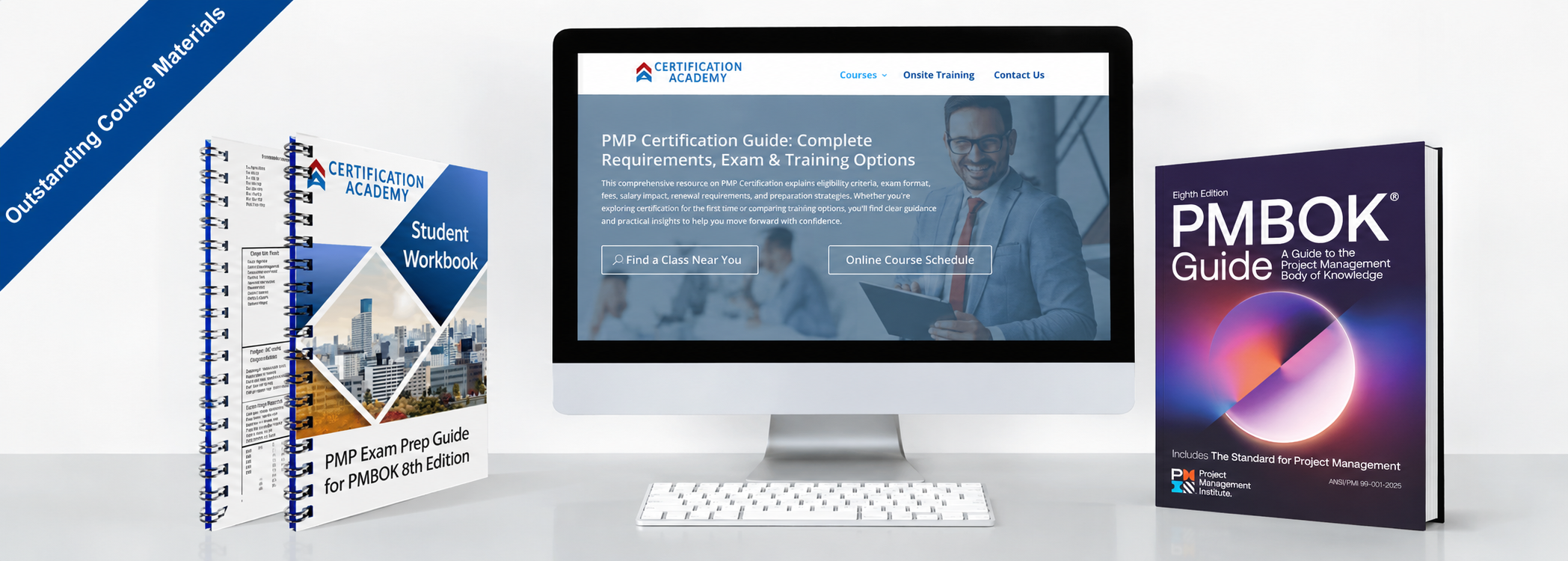
Our PMP Course material is well-organized and mapped to include other data sources referenced in the PMP exam.
PMP Certification Course Syllabus
- Recall key inputs, tools and techniques, and outputs for each Project Management Body of Knowledge process
- Recall key project management formulas (earned value technique, forecasting, procurement, and communications lines)
- Create and interpret a schedule network diagram
- Articulate the fundamental principles of the PMBOK knowledge areas
- Navigate scenario based questions, and given a list of alternatives, determine the appropriate input, tool, and technique, or output that applicable in the situation
- Determine and apply the appropriate project management formula in situational based scenarios.
- Choose the best answer based on an understanding of the PMBOK knowledge areas and code of conduct.
Here is more information relating to what you will learn in the PMP Boot Camp Class:
Module 1 – Starting with the End in Mind
Project Management Roles & Environments PMI Terminology and Structure Professional Responsibility PMP Exam strategies & tips and tricks
Module 2 – Creating and Managing High Performing Teams
Creating and Leading High Performing Teams Define Team Ground Rules Build Shared Understanding, Manage Conflict Negotiate Project Agreements Empower Team Members and Stakeholders Ensure Team Members and Stakeholders Are Trained Engage and Support Virtual Teams Support Team Performance and Apply Emotional Intelligence Address and Remove Impediments, Obstacles, and Blockers Collaborate and Mentor Stakeholders
Module 3 – Planning and Managing the Project Work
Determine Appropriate Project Methodology/Methods and Practices Plan and Manage Scope, Budget, Resources and Schedule Plan and Manage Quality of Products/Deliverables Integrate Project Planning Activities Plan and Manage Procurement Establish Project Governance Structure Assess and Manage Risks Execute Project to Deliver Business Value Manage Communications Engage Stakeholders Create Project Artifacts Manage Project Changes and Issues Ensure Knowledge Transfer to Project Continuity
Module 4 – Managing the Business
Manage Compliance Requirements Evaluate and Deliver Project Benefits and Value Evaluate and Address Internal and External Business Environment Change Support Organizational Change Employ Continuous Process Improvement
Module 5 – Final Exam
Review of Questions & Answers Stoplight Assessment Each class includes hands-on course exercises including: Practice exercises targeted at the range of learning styles Network Diagram Exercises Earned Value Exercises Chapter Specific Practice Tests 90-day Access to a PMP Certification Exam Simulator Download Course Outline
PMP Course Methodology
Our instructor-led PMP training course delivers results through our proven CAMPS Methodology – transforming overwhelmed professionals into confident, certified project managers in just four intensive days. While self-study achieves roughly 61% pass rates, CAMPS consistently delivers 98% success.
The CAMPS Advantage: Why Our PMP Certification Rates Soar to 98%+
The CAMPS Methodology isn’t just a clever name – it’s five essential pillars delivered through a proven ascent strategy. Each camp on your journey focuses on one critical element: Coaching, Application, Mastery, Performance, and Success. Read more about our CAMPS methodology.
The CAMPS Methodology: Strategic Camps to Reach Your Certification Summit
- ⛺ BASE CAMP: Foundation
- 🏔️ CAMP 1: Building
- 🏔️ CAMP 2: Application
- 🏔️ CAMP 3: Practice
- 🏔️ CAMP 4: Push for Success
Expert Coaching That Changes Everything: Experience real-time guidance from instructors who’ve guided thousands of students through this exact PMP certification training journey. They are able to instantly identify knowledge gaps, clarify less common terms like earned value management, and connect your real-world experience to PMI’s methodology. This is the Coaching pillar in action – personalized attention you can’t get anywhere else.
Proven Learning Science + Pattern Recognition: Through our Application pillar, we blend cognitive science with practical exercises:
- Spaced repetition within the intensive format
- Visual frameworks organizing complex concepts
- Memory techniques for formulas and calculations
- Pattern recognition for “PMI mindset” questions
- Exam simulators mirroring actual PMP test difficulty and format
The Immersion & Accountability Advantage: Our Mastery approach means four days of complete immersion – free from distraction like emails, calls, or work emergencies. The concentrated format builds momentum rather than losing knowledge between scattered sessions. Your time investment creates powerful accountability, ensuring you complete preparation while material is fresh.
Peer Learning & Performance Optimization: The Performance pillar leverages group dynamics. Learn alongside professionals, hear different perspectives, and build confidence through discussions. Understand your outliers as you build on your strengths. Many students say this peer interaction is unexpectedly valuable – not just for learning, but for building PMP exam confidence.
What You’ll Learn
- Identify and overcome knowledge gaps
- PMI application support
- Increase comfort and ability with PMP Exam questions
- Learn useful tips and tricks to increase comprehension
- Learn and apply critical test-taking strategies
- Apply real-world project management concepts
- Complete exam readiness
What’s Included
- Comprehensive Pre-Class Study Guide
- 35 hours of PMI approved education
- Online PMP exam simulator
- 1000+ Practice Questions
- In-Class Exercises
- 100% Exam Pass Guarantee
- Lunch and Snacks Provided During In Person Classes

Firm Course Dates
100% Money Back Guarantee
Experience
Thought Leadership
Proven Results
See What Our PMP Boot Camp Students Have to Say
The Project Management Institute (PMI) makes no secret of the difficulty involved in passing the PMP Certification exam. It’s a challenging test, and even experienced project managers with impressive track records sometimes walk away without a passing score. It’s not due to a lack of effort or commitment, in fact many learners spend a lot of time and energy on self-study preparation. The honest truth is, no matter how much you study, if you’re not focusing on the correct material, your chances of passing are slim.
Research shows that about half of the people who plan to sit for the PMP exam never actually take it. You might assume that those who do finally register are well prepared, and therefore the pass rate would be high. Unfortunately, many PMP exam takers report that the exam is extremely difficult, with a passing rate of around 60% on the first attempt, leaving many accomplished professionals wondering where they went wrong. Many people even make the mistake of retaking the exam without significant additional study.
Why do so many capable project managers fail to pass an exam that assesses skills they use every day? The reason lies in the difference between mastering your job through real-world experience and excelling in a structured, knowledge-based exam. The level of difficulty can vary depending on a person’s prior project management experience and their preparation for the exam. Just as a skilled professional might excel at applying concepts on the job but struggle with a theoretical test, many project management certification candidates find the exam format requires more than just practical knowledge. Understanding PMI’s framework, terminology, and methodology is essential for success. The foundational concepts and “PMI approach” to the exam are exactly what we cover in our PMP certification training boot camps.
How to Apply for PMP Certification
Candidates for Project Management Certification must complete an online application with the Project Management Institute (PMI). The application asks you to detail several years of your work history and education. Use concise descriptions to describe the project management tasks the candidate led or directed for each project. We recommend that you gather all the relevant information related to your PMP application before you begin. Once started, you have 90 days to complete it. It has an auto-save function so you can come back to it if you take a break from working on it.
Before submitting the application, you will need to read and agree to PMI Code of Ethics & Professional Conduct as well as the PMP Certification/Renewal Agreement. PMI will review your application. If it is approved, you pay the exam fee and PMI emails you a PMI Eligibility ID, which you use to schedule the exam. If your application is selected for an audit, PMI notifies you by email before you pay.
What happens after I submit my PMP application?
What is a PMP Certification Audit?
Maintaining PMP Certification
How often do I need to renew my PMP certification?
Do I have to renew my PMI Membership?
You do not have to be a PMI member to remain PMP certified, nor do you need to be a PMI member to get your certification. Many project managers join PMI as they prepare for the PMP exam because they receive a substantial discount on the exam fees. The discount is greater than the yearly PMI membership, so it makes a lot of sense to join.
How do I earn the 60 PDUs I need to renew?
- Minimum of 35 Education PDUs
- Maximum of 25 Giving Back PDUs
As a PMP certificate holder, you must earn a minimum of 8 PDUs in each skill area of the PMI Talent Triangle – Ways of Working, Power Skills, and Business Acumen. Maintaining your certification is crucial in this fast-paced industry. Continuous learning ensures you stay competitive and relevant. The requirement to earn PDUs aligns with the PMI‘s Talent Triangle®, which focuses on a balanced skill set necessary for effective project management. For details on earning and reporting PDUs, see PMI’s Maintain page. Planning your professional development early helps you keep your certification active.
PMP Certification Frequently Asked Questions
Do I have to be a PMI Member?
How do I schedule a time to sit for the PMP Certification exam?
What study materials are provided in the PMP course?
-
- We provide complete PMP course materials to our students. In addition to comprehensive study materials, references, and study aids, our students receive a 90-day subscription to our online learning platform, which includes an exam simulation with over 1,000 practice questions.
- Students are encouraged to purchase the current edition of A Guide to the Project Management Body of Knowledge®, available at the PMI Bookstore or other retailers. PMI Members have access to a free e-copy of the PMBOK® Guide online that may be downloaded.
- All the questions on the examination have been written and extensively reviewed by qualified PMP credential holders and tracked to at least two academic references. These questions are mapped against the PMP Examination Content Outline to ensure that an appropriate number of questions are in place for a valid examination.
- Sample exam questions and suggested reading are also available on the PMI website.